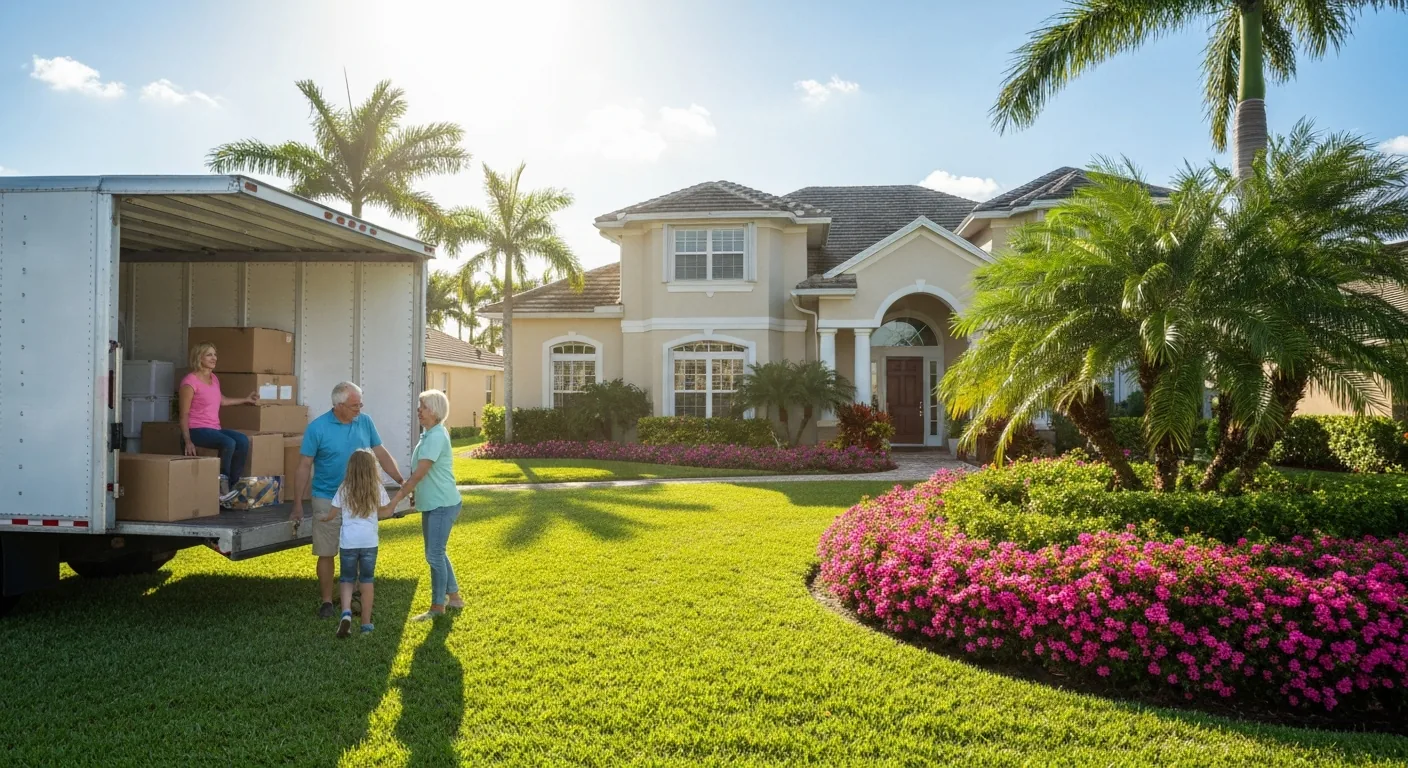
Why People Are Moving to Florida in Record Numbers
Florida added a net 365,000 new residents in 2024 — the largest domestic migration gain of any state for the third consecutive year. The top origin states were New York, California, New Jersey, Illinois, and Massachusetts.
The primary motivators, according to United Van Lines’ 2024 National Movers Study:
| Reason for Moving to Florida | % of New Arrivals |
|---|---|
| Lower taxes / cost of living | 34% |
| Retirement / lifestyle | 28% |
| Job or remote work relocation | 21% |
| Family proximity | 12% |
| Climate preference | 5% |
The financial case is compelling, but Florida is not a low-cost state across the board. Understanding where to live matters as much as deciding to move.
Florida Cost of Living by City (2026)
Florida’s cost of living varies dramatically by location. The US average is indexed at 100.
| City | COL Index | Avg 1BR Rent | Avg Home Price | Notes |
|---|---|---|---|---|
| Miami | 128 | $2,450 | $685,000 | Highest COL in FL |
| Naples | 124 | $2,200 | $710,000 | Retiree destination |
| Fort Lauderdale | 118 | $2,100 | $580,000 | Miami metro commutable |
| Orlando | 108 | $1,750 | $395,000 | Growing tech hub |
| Tampa | 106 | $1,800 | $415,000 | Strong job market |
| Jacksonville | 96 | $1,450 | $310,000 | Affordable, growing |
| Gainesville | 93 | $1,250 | $285,000 | University city |
| Ocala | 92 | $1,100 | $255,000 | Lowest COL major FL city |
| Tallahassee | 94 | $1,200 | $265,000 | State capital, stable |
| Pensacola | 95 | $1,300 | $290,000 | Gulf Coast affordable |
Source: Council for Community and Economic Research (C2ER) Q1 2026
The Income Tax Savings Calculation
Florida’s no-income-tax status saves money — but how much depends on where you’re coming from.
Annual income tax savings for a household earning $120,000:
| Origin State | State Income Tax Rate | Annual Savings Moving to FL |
|---|---|---|
| California | 9.3% | ~$11,160 |
| New York | 6.85% | ~$8,220 |
| New Jersey | 6.37% | ~$7,644 |
| Illinois | 4.95% | ~$5,940 |
| Massachusetts | 5.00% | ~$6,000 |
| Georgia | 5.49% | ~$6,588 |
| Texas | 0% | $0 (already no state tax) |
Note: Actual savings depend on deductions, filing status, and local taxes. Consult a CPA for personal tax advice.
These savings can offset a significant portion of higher housing costs, particularly in mid-range Florida markets like Orlando and Jacksonville.
Property Taxes and the Homestead Exemption
Florida’s property tax system includes one of the most valuable homeowner protections in the country: the Homestead Exemption.
What it does:
- Reduces your assessed home value by up to $50,000 for property tax purposes
- Caps annual assessed value increases at 3% per year (Save Our Homes cap)
- Applies only to your primary residence
How to apply:
- File with your county property appraiser by March 1 of the year after you establish residency
- You must have owned and occupied the home as your primary residence on January 1
- Required documents: Florida driver’s license, Florida vehicle registration, voter registration (if applicable), and Social Security number
On a $400,000 home with a 1.1% effective tax rate, the Homestead Exemption saves approximately $550 per year in perpetuity — and the 3% cap protects you from future assessment spikes in rising markets.
Choosing the Right Florida City for Your Lifestyle
Best for professionals and career growth:
- Tampa — tech, finance, healthcare; 3.8% unemployment rate in 2025
- Orlando — tourism tech, simulation, aerospace; strong remote-work infrastructure
- Jacksonville — banking, logistics, military contractors; lowest housing cost of major FL cities
Best for retirees:
- Sarasota — arts scene, beaches, world-class healthcare (Sarasota Memorial)
- Naples — ultra-low crime, golf communities, exceptional weather
- The Villages — dedicated 55+ community, largest in the US (140,000+ residents)
- Clearwater — Gulf beaches, affordable vs. Miami, active senior community
Best for families:
- St. Johns County (Jacksonville suburbs) — #1 school district in Florida
- Winter Garden (Orlando suburb) — A-rated schools, low crime, new construction
- Bradenton/Lakewood Ranch — master-planned, top-rated schools, Sarasota beaches nearby
Best for young adults / remote workers:
- St. Petersburg — arts, food scene, walkable downtown, Lower cost than Miami
- Gainesville — University of Florida culture, lowest cost of living in FL
- Dunedin — beach town vibe, cycling trails, craft beer scene, community feel
Hurricane Preparedness: What New Floridians Must Know
This is the most overlooked aspect of relocating to Florida. Hurricane preparation isn’t optional — it’s an annual responsibility.
Hurricane Season: June 1 – November 30 (peak: August–October)
Your first steps as a new Florida resident:
- Determine your flood zone at msc.fema.gov — flood insurance is required in high-risk zones (A, AE, VE)
- Purchase homeowner’s insurance with hurricane/wind coverage — standard policies often exclude wind damage
- Review the Saffir-Simpson scale — Category 1–5 definitions
- Know your evacuation zone (A–F in most counties, check your county emergency management website)
- Build a 7-day emergency kit:
- 1 gallon of water per person per day (7 gallons minimum)
- 7-day food supply (non-perishable)
- Battery-powered or hand-crank radio
- Flashlights and extra batteries
- First aid kit
- 30-day medication supply
- Important documents in waterproof container
- Cash (ATMs fail during power outages)
Insurance reality check:
Florida homeowners insurance averages $3,200/year statewide — nearly 3x the national average. Miami-Dade and Broward counties average $5,500–$8,000/year. This is a significant ongoing cost that many newcomers don’t budget for.
Wind mitigation inspections ($150–$300) can reduce your premium by 15–40%. Many older Florida homes benefit dramatically from wind mitigation credits.
Florida Driver’s License and Vehicle Registration
Florida requires new residents to convert their license and register their vehicle within 30 days of establishing residency.
Driver’s License (Florida DHSMV):
- Surrender your out-of-state license
- Provide: proof of identity, Social Security number, 2 proofs of residential address, proof of legal presence
- Cost: $48 (8-year license)
- Vision test required; knowledge/skills tests only if license is expired or from a non-reciprocal state
Vehicle Registration:
- Requires Florida insurance proof (minimum: $10,000 PIP + $10,000 PDL)
- Title transfer if you own the vehicle
- Registration fee: $225 initial + annual renewal (varies by county)
- Annual cost in most counties: $80–$180
Florida does not require vehicle inspections (no emissions test) — one fewer bureaucratic step compared to most northern states.
Your Florida Relocation Checklist
3–6 months before moving:
- Research Florida cities and neighborhoods
- Visit your target city if possible (off-season: September–March)
- Contact 3+ interstate movers for binding estimates
- Research Florida homeowner’s / renter’s insurance
- Plan for flood zone status and flood insurance if needed
- Research school districts if moving with children
1–3 months before moving:
- Confirm moving company and sign binding contract
- Give notice at current residence
- Forward mail via USPS (usps.com/move)
- Transfer medical records and find FL doctors/specialists
- Notify banks, credit cards, subscriptions of address change
- Obtain school records if applicable
Moving week:
- Confirm moving company details and arrival time
- Pack essentials bag (medications, valuables, chargers, 3 days of clothes)
- Take photos/video of all items before loading (for insurance claims)
- Document any existing damage to your new home before moving in
First 30 days in Florida:
- Get Florida driver’s license (DHSMV office — book appointment online)
- Register your vehicle
- Register to vote (if desired) at registertovoteflorida.gov
- Apply for in-state tuition (if applicable) — 12-month residency required for university
- Update address with IRS (Form 8822)
- Apply for Homestead Exemption if you purchased a home (by March 1 of next year)
- Purchase hurricane kit supplies
- Know your evacuation zone
First year:
- File Homestead Exemption by March 1 if applicable
- Reassess insurance coverage after first hurricane season experience
- Explore Florida state parks — 175 parks covering 800,000 acres
Common Mistakes New Florida Residents Make
Underestimating insurance costs. Many people budget for the mortgage but not the $4,000+/year in Florida homeowners insurance. Get insurance quotes before you close on a home.
Ignoring flood zones. About 17% of Florida properties are in high-risk flood zones — but flooding from heavy rain can affect any property. Even properties outside FEMA flood zones experience flooding in major storms.
Moving during peak season. May–August is both the most expensive time to hire movers AND hurricane season. If you can close on your Florida home in the fall, you’ll pay less for movers and have time to settle in before next summer.
Choosing coastal over inland without calculating total cost. A waterfront condo may be $150,000 cheaper than an equivalent inland home — but the insurance difference can be $4,000–$8,000 per year, making the coastal property more expensive long-term.
Not verifying the moving company. Florida is one of the top states for moving fraud. Always verify your mover’s USDOT number at safer.fmcsa.dot.gov before signing anything.